 TalentLink
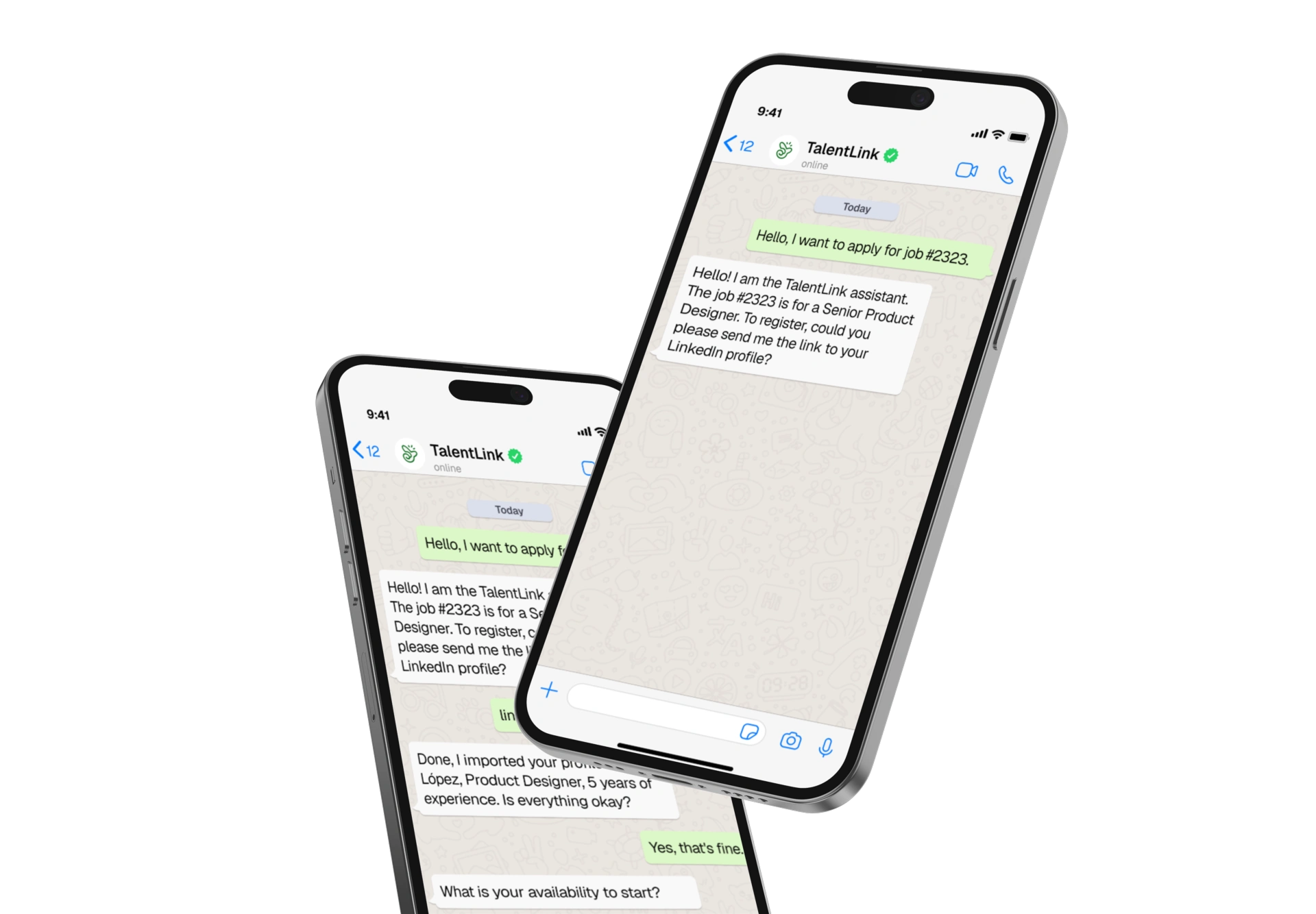
, una plataforma de reclutamiento, perdía 6 de cada 10 candidatos en el formulario de postulación. Ideé un flujo conversacional por WhatsApp que importa el perfil de LinkedIn y adapta las preguntas a cada búsqueda. El abandono bajó del 60% al 40%, y después de iterar con datos llegó al 28%.
Profesionales interesados en una búsqueda puntual. Llegan desde una publicación en LinkedIn, un link compartido o un contacto directo.
Su experiencia ya está en LinkedIn. Volver a cargarla a mano en un formulario es pura fricción.
Dejar sus datos en un sitio que no conocen les genera desconfianza.
Responden si la pregunta tiene que ver con el puesto. Las genéricas, o una charla sin rumbo, los hacen abandonar.

Un formulario largo y genérico, frente a un volumen alto de postulaciones todos los días.
La implementó un equipo de 3 devs, porque el sistema combinaba varios agentes de IA.
El asistente gestionaba toda la cuenta del talento, incluidas respuestas a consultas posteriores de la empresa cliente.
Las preguntas tenían que adaptarse a cada empleo.
El equipo de reclutamiento necesitaba candidatos listos rápido, lo que condicionó los tiempos del flujo (ver Iteración).
El funnel estaba instrumentado con PostHog: cada paso registraba hasta dónde llegaba el candidato. Un dev se encargaba de las métricas.
Eso permitió ver dónde se caían los usuarios y comparar cada versión con datos reales, no con supuestos. Fue la base de todas las decisiones que siguen.
Antes de llegar al bot probé dos caminos que no funcionaron. Ubicados en un mapa, el patrón se ve solo.
Un canal que ya usan y en el que confían, con preguntas acotadas.
La gente se iba: una charla sin estructura generaba más fricción que el formulario.
Los candidatos desconfiaban de dejar sus datos en un sitio que no conocían.
El abandono bajó del 60% al 40%, pero no era donde queríamos llegar.
Seguíamos perdiendo 4 de cada 10 candidatos, y PostHog mostraba que se iban en el medio del flujo: el chat seguía pidiendo demasiado de una sola vez.
¿Y si la postulación terminaba antes? Partí el flujo en dos. Primero, una postulación mínima, tan simple como la "Solicitud sencilla" de LinkedIn. Después de una pausa, el bot avisaba: "pasaste de fase". Recién ahí llegaban las preguntas del puesto.
Tan simple como la "Solicitud sencilla" de LinkedIn.
Después de una pausa, el bot avisa:
⬆ Pasaste de faseLas preguntas específicas de cada búsqueda, con el candidato ya comprometido.
Avanzar de fase se sentía como un premio. El candidato ya no estaba completando un trámite: estaba progresando. El abandono bajó al 28%.

El bot importa el perfil de LinkedIn, así no hay que cargar datos a mano.
Unas pocas preguntas y la postulación ya queda hecha.
Minutos después, el aviso de avance.
Específicas de cada búsqueda.
El mismo asistente responde después consultas de la empresa cliente.
Del formulario original al bot con flujo partido, medido en PostHog.
postulaciones completas más por día, que hiring ya no pierde ni tiene que salir a buscar.
Sobre 150 a 200 postulaciones iniciadas por día: antes se completaban 60 a 80, ahora 108 a 144.
El mayor desafío fue el modo de conversar del bot: lo que decía y cómo lo decía hacía que los usuarios reaccionaran de formas distintas.
Si lo encarara de nuevo, definiría desde el principio una guía de tono y personalidad del asistente, y la testearía con candidatos reales.
TalentLink, a recruiting platform, was losing 6 out of 10 candidates on its application form. I came up with a conversational WhatsApp flow that imports the LinkedIn profile and adapts the questions to each job opening. Drop-off went from 60% to 40%, and after iterating with data it reached 28%.
Professionals interested in a specific opening. They arrive from a LinkedIn post, a shared link or a direct contact.
Their experience is already on LinkedIn. Typing it into a form again is pure friction.
Leaving their data on a site they don't know makes them wary.
They answer when the question relates to the role. Generic ones, or an aimless chat, make them leave.
A long, generic form, facing a high volume of applications every single day.
A team of 3 devs built it, because the system combined several AI agents.
The assistant managed the candidate's whole account, including answers to later questions from the client company.
The questions had to adapt to each job.
The recruiting team needed candidates ready fast, which shaped the flow's timing (see Iteration).
The funnel was instrumented with PostHog: each step logged how far the candidate got. One dev owned the metrics.
That let us see where users dropped off and compare each version with real data, not assumptions. It was the basis for every decision that follows.
Before landing on the bot I tried two paths that didn't work. Placed on a map, the pattern shows itself.
A channel they already use and trust, with focused questions.
People left: an unstructured chat created more friction than the form.
Candidates didn't trust leaving their data on a site they didn't know.
Drop-off fell from 60% to 40%, but that wasn't where we wanted to land.
We were still losing 4 in 10 candidates, and PostHog showed they left in the middle of the flow: the chat was still asking for too much at once.
What if the application ended sooner? I split the flow in two. First, a minimal application, as simple as LinkedIn's "Easy Apply". After a pause, the bot said: "you moved to the next stage". Only then did the job questions come in.
As simple as LinkedIn's "Easy Apply".
After a pause, the bot says:
⬆ You moved to the next stageThe questions specific to each opening, with the candidate already committed.
Moving up a stage felt like a reward. The candidate was no longer filling out paperwork: they were making progress. Drop-off fell to 28%.
The bot imports the LinkedIn profile, so there's no manual data entry.
A few questions and the application is done.
Minutes later, the progress notice.
Specific to each opening.
The same assistant later answers questions from the client company.
From the original form to the bot with the split flow, measured in PostHog.
more completed applications per day that hiring no longer loses or has to go chase.
Out of 150 to 200 applications started per day: 60 to 80 used to be completed, now 108 to 144.
The biggest challenge was the bot's way of talking: what it said and how it said it made users react in different ways.
If I did it again, I'd define a tone and personality guide for the assistant from the start, and test it with real candidates.